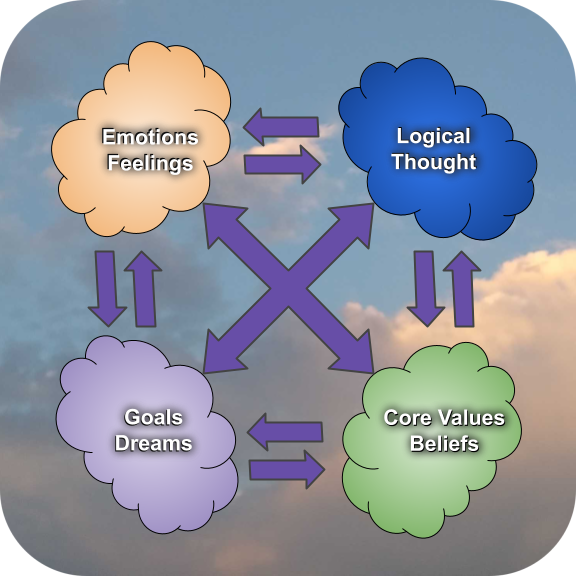
We frequently want to practice these tools, yet we don’t know how. This is where the discipline of self-compassion becomes invaluable.
Three skills are frequently involved in your journey of teaching yourself to be self-compassionate: awareness, acceptance, and letting go. This month, we will use the first two.
Last month’s newsletter introduced the idea of awareness, and specifically, seeing your mind processing data or thinking. To practice acceptance, one first must recognize areas of mental activation and use the question, “What am I thinking?” as a starting point. If you can’t recognize any thoughts, look at how you’re feeling and then internally look at the thoughts driving those feelings. Notice any emotions you are experiencing; positive or negative isn’t essential right now, noticing you’re feeling emotions is. Once you’ve discovered thoughts or emotions you’re experiencing, you’re ready for acceptance.
First, try to allow the thoughts and feelings to exist in your body. Acceptance asks us to recognize that there are parts of our mind that want to resist or hold on to the activation. Try to consciously experience the thoughts and feelings passively. If the feeling is negative, it may feel uncomfortable, and if the feeling is positive, it may seem wrong not to feed the feeling with more thought. Thus, I recommend you start with some small, logically unimportant experiences, like the feelings of irritation you experience when the network shows a commercial in the middle of an engaging scene.
Using that example, notice the layers of thoughts and emotions you’re feeling. Watch them float around your brain/body; see them pressure you to take some type of action like a scowl or throwing the couch at the TV. Then, gently ask your mind to sit back and watch as if you were watching the wind blow the leaves on a breezy day.
This exercise of passively watching your mind wrestle with its myriad thoughts and feelings may seem challenging. If it is, gently calm its activities and try to simply accept that your mind is thinking.
Using minor, unimportant things, compassionately train your mind to watch and acknowledge without personalizing the emotional activations it’ll experience; this is awareness and acceptance in action! With practice, you’ll improve this skill so that, eventually, even the most sensational situations elicit only a minimum of emotion in your mind. At that point, most of the thoughts and emotions your brain/body experiences will be under your control.
You can learn this skill! I believe in you.